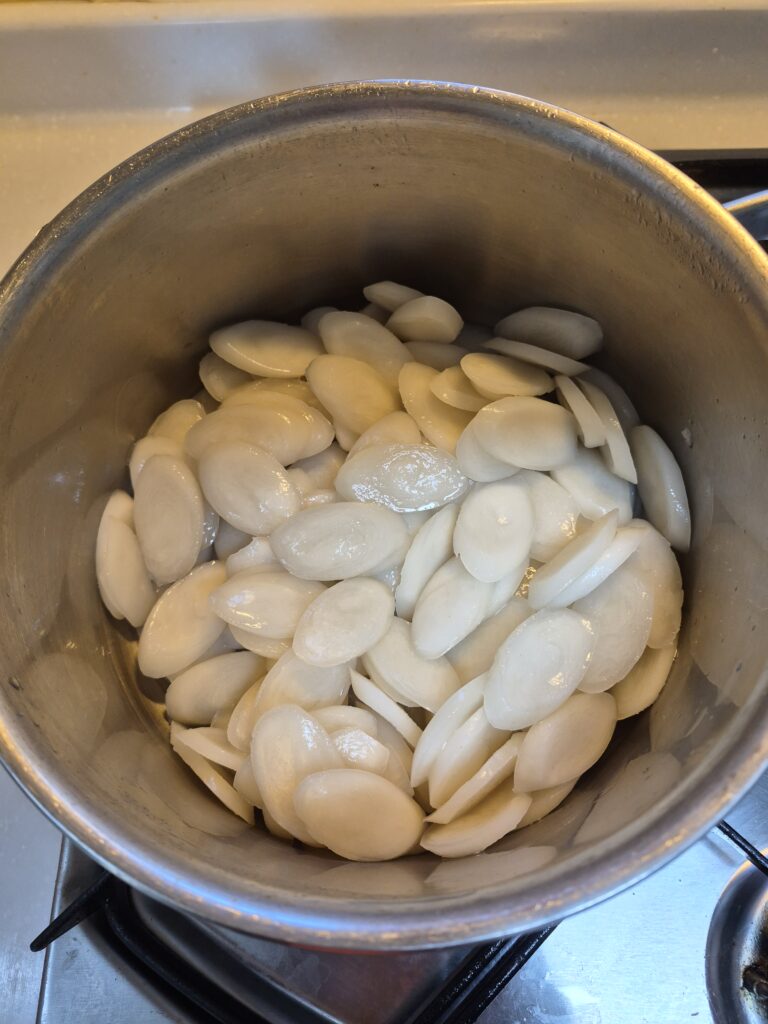
“While Tteokguk is the iconic dish for the Lunar New Year, in my home, it’s a go-to comfort meal for any day of the week. Today, I paired a rich, savory Tteok-Mandu-guk (Rice Cake & Dumpling Soup) with a fresh side of Kongnamul-muchim (Seasoned Soybean Sprouts). It’s a nutritious, high-protein meal that’s surprisingly easy to whip up!”
Quick Steps: Boil the broth and water, add rice cakes and dumplings, and finish with a dash of black pepper and shredded seasoned seaweed (Gim).
[Side] Super Simple Kongnamul-muchim
Ingredients: 1 bag of soybean sprouts, chopped green onions, ground sesame seeds, and a drizzle of sesame oil.
Method: Steam sprouts in a wok with a splash of water (lid closed), drain, and toss with seasonings. It’s the easiest way to add fresh fiber to your meal!
The Secret to a 10-Minute Deep Broth (Bibigo Sagol Gomtang)
Making authentic Sagol (Beef Bone Broth) usually requires simmering bones for over 8 hours. For a busy weekday, I rely on Bibigo Sagol Gomtang.
That’s why I love this Bibigo Sagol Gomtang. It’s incredibly convenient and delivers that signature rich, nutty, and deep flavor instantly. Since it’s shelf-stable, you can stock up your pantry without taking up fridge space.
Lee’s Tip: “This pouch is a pantry essential! It’s shelf-stable and delivers a professional, deep flavor instantly. I use it as a base not only for Tteokguk but also for Kimchi-jjigae and Doenjang-jjigae to add incredible depth.”
It’s not just for Tteokguk, either! It works as a perfect, savory base for various Korean stews like:
Kimchi-jjigae (Kimchi Stew)
Doenjang-jjigae (Soybean Paste Stew)
Budae-jjigae (Army Stew)
It adds a layer of depth that water alone just can’t match!”
Hello, I’m Jennie. Born and raised in Seoul, I now live in Ilsan, Gyeonggi-do with my three sons.
As a 25-year working mom, I try my best to cook affordable, simple, nutritious Korean home meals that are good for health and easy on the waistline—even on the busiest days.
Here, I share easy, budget-friendly Korean recipes packed with goodness and my family’s little secrets!
Today, I’m excited to share one of our family favorites: Kimchi Jjigae (Kimchi Stew).
If there is one dish that represents the heart of Korean home cooking, it is undoubtedly Kimchi Jjigae. Every Korean family has their own secret version, and today I’m sharing mine with you!
Ingredients (Serves 2-3 as main dish)
Well-fermented (sour) kimchi: 400-500g (about 2-3 cups packed, bite-size cut) – Use E-mart or store-bought aged for 1-2 months!
Kimchi juice (brine): 1/2 cup (about 120ml) – The more sour, the better!
Onion: 1 medium (about 150g), sliced 0.5cm thick
Green onions: 2 stalks (about 50g), diagonal cut (eo-geut-sseol-gi)
Calories: 250–350 kcal (depending on pork cut and fat)
Carbs: 10–15g
Fat: 12–18g
Sodium: 900–1,300mg
Fiber: 4–6g
Why it’s protein-packed & healthy This stew uses 300g pork and a full 400g block of tofu, delivering around 20g of protein per serving – perfect for keeping you full longer, supporting muscle health, and making it a satisfying meal even on diet days! Pork adds rich flavor and complete protein, while tofu boosts it with plant-based goodness – no extra effort needed.
1. Choosing the Right Kimchi
“When it comes to Kimchi, I usually purchase mine from reliable online stores, but I always make sure to check that it is 100% made from Korean-grown ingredients.
The secret to great Kimchi starts with the cabbage itself. Korean napa cabbage is uniquely firm and crisp, thanks to the specialized seeds developed by the renowned scientist Dr. Woo Jang-choon. These seeds were specifically bred to create cabbage that stays crunchy and doesn’t get mushy during the fermentation process—making it the essential choice for authentic, high-quality Kimchi.”
The real secret? Patience! Even store-bought kimchi needs to rest in the fridge for at least 1-2 months to fully ferment into ‘Sin-Kimchi’ (well-fermented, sour kimchi).
This extra fermentation time develops that deep, natural tangy acidity that gives the stew its signature bold and refreshing punch.”
Why Korean Cabbage Makes the Best Kimchi
My Tteokguk wouldn’t be complete without Kimchi! I usually purchase mine from reliable online stores, but I always make sure to check that it is 100% made from Korean-grown ingredients.
The Science of Crunch: “The secret lies in the seeds. Korean napa cabbage was perfected by the renowned scientist Dr. Woo Jang-choon. These specific seeds produce cabbage that is firm and crisp, ensuring it stays crunchy and never gets mushy during fermentation.”
2. Precise Ingredient Prep Details
“Precision in cutting makes a big difference for the perfect texture and bite. I recommend slicing the onions about 0.5cm thick so they keep a slight crunch even after simmering.
For the green onions, use a diagonal cut (called ‘eo-geut-sseol-gi’ in Korean) – it not only looks more professional and elegant, but also helps release more flavor into the broth as they cook.”
3. What is Tuna Fish Sauce? (My Go-To Choice) If you’re new to Korean ingredients, tuna fish sauce (chamchi aekjeot) is a magical umami booster. It’s much less “fishy” than regular anchovy fish sauce and adds a clean, savory depth without overpowering the dish.
I personally use Sajo Tuna Fish Sauce because:
It’s very affordable and comes in a large bottle (great value!).
The taste is clean and not too strong – perfect for beginners.
Making anchovy broth from scratch is time-consuming on busy days, so this gives almost the same deep flavor with zero effort!
You can find it or similar ones on Amazon: Get Sajo Tuna Katsuo Sauce (500ml) here (As an Amazon Associate, I earn from qualifying purchases – thank you for your support!)
Start with 1 tsp and taste – you can always add more!
4. Authentic Korean Eating Style (How to Enjoy It Like a Local)
“To eat like a true Korean, try the ‘Kim-Ssam’ method: Place a spoonful of hot steamed rice on a piece of roasted seaweed (gim), top it with a soft, flavorful piece of kimchi straight from the stew, and wrap it up into a bite-sized package.
The contrast between the crispy, salty seaweed and the hot, spicy, tangy kimchi creates an incredible flavor explosion – it’s the ultimate soul food experience that captures the heart of Korean home cooking.”
Step-by-Step
Layer the Ingredients: Place the Kimchi, sliced onions, and green onions into the pot.
Add the Flavor: Pour in the Kimchi juice and add one teaspoon of tuna fish sauce. This is the secret to a deep, savory broth without frying.
‘Lee’s Tip’
“The secret to this clean-tasting Kimchi Jjigae is the tuna fish sauce. It adds an incredible ‘Umami’ without making the soup heavy. Also, using well-fermented (sour) Kimchi is a must!”
Boil Gently: Add water (or broth) until the ingredients are submerged, and bring it to a boil over medium-high heat.
Finish with Tofu & Green Onions: Once the stew is boiling and the Kimchi becomes tender, add the sliced tofu and green onions on top. Simmer for another 5 minutes to let the flavors soak in.
“A perfect Korean home-cooked meal is never complete without a few side dishes.
Today, I paired my Kimchi Jjigae with steamed white rice, crispy roasted seaweed, sweet and savory stir-fried anchovies, and a fried egg. This is the ultimate comfort food that every Korean loves!”
The Full Spread
Steamed White Rice
Kimchi Jjigae
Roasted Seaweed (Gim)
Stir-fried Anchovies (Myeolchi-bokkeum)
Fried Egg (Well-done / Hard-fried)
Lee’s Style: “I personally prefer a hard-fried egg with Kimchi Jjigae. The fully cooked yolk tastes so nutty and savory when mixed with the spicy stew broth!”